📌 挂靠声明 本页挂靠于 BlueEve 的主页 · blogs.blueeve.top,子域名与服务器由站长友情提供 Hosted under blogs.blueeve.top — content is provided by the author only
I am currently applying to graduate programs starting Fall 2027. Please feel free to reach out by email.

Zhangqi Zheng

Information and Computational Science, College of Sciences, Nanjing Agricultural University

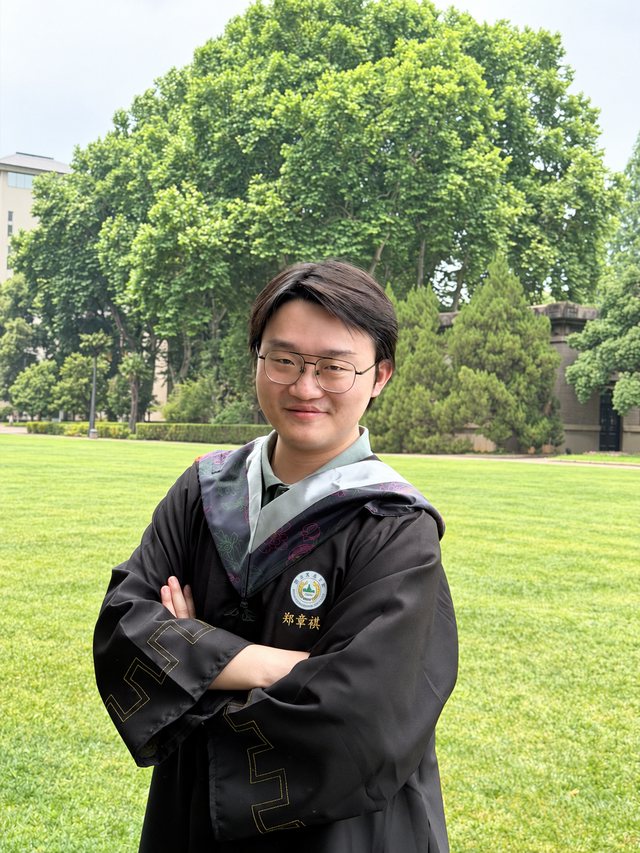
Portrait of Zhangqi Zheng
Nanjing, China
23123223@stu.njau.edu.cn
+86 158-5032-7392
github.com/zzqxiaolaji

I am an undergraduate in Information and Computational Science at Nanjing Agricultural University. My interests lie where stochastic analysis, scientific computing and machine learning meet, and I am currently working on the finite-time stability of discrete-time stochastic forced systems.

Stochastic Systems & Stability Financial Mathematics & Time Series Scientific Computing & LLM Agents Reinforcement Learning Theory Interpretable Machine Learning

news

2026.03 A Frequency Attribution Analysis Framework for Multi-Scale Driving Factor Decomposition in Commodity Futures submitted to Applied Mathematical Modelling; under review.
2025.11 Presented at BDCIA 2025 (Huanggang, China); Differential-Agent accepted and published in the SPIE conference proceedings.
2025.10 Travelled to Paris for the iGEM 2025 Grand Jamboree, presenting the modelling work on behalf of team NAU-CHINA.
2025.04 A Study of Exploration-Exploitation Strategies in Unconventional Situations accepted at AIDML 2025.

research interests

Stability and Finite-time Analysis of Stochastic Systems

Nonlinear dynamical systems subject to external disturbances and stochastic forcing, with a focus on finite-time stability, input-to-state stability (ISS) and quantitative bounds on convergence time. Methodologically centred on nonsmooth Lyapunov functions and Itô stochastic calculus, aiming at necessary and sufficient criteria under weak assumptions such as non-differentiable disturbances and non-Gaussian noise.

Financial Mathematics and Interpretable Forecasting

Decomposition, modelling and attribution of multi-scale time series: separating frequency components via variational mode decomposition, characterising scale-dependent dynamics with heterogeneous models, and quantifying cross-frequency differences among driving factors using SHAP and permutation importance, with applications of stochastic modelling to markets and commodity futures.

Scientific Computing and LLM Agents

Addressing incomplete reasoning and unreliable numerical output when large language models are used for scientific computing. A multi-agent framework makes mathematical modelling, code generation and numerical solving explicitly separable, so that each stage is verifiable and traceable — improving accuracy and robustness on numerical tasks.

Theory and Algorithms of Reinforcement Learning

Theoretical foundations and algorithmic improvements for the exploration–exploitation trade-off, particularly multi-armed bandits and deep reinforcement learning in unconventional settings — non-stationary, delayed-reward, contextual and adversarial — analysed for stability and convergence consistency through statistical learning theory.

research experience

Finite-time Stability of Discrete-Time Stochastic Forced Systems

2024.09 – present
Provincial SRT Project · Lead contributor
  • Stability analysis: constructed nonsmooth Lyapunov functions for nonlinear discrete systems with external disturbances, handling non-differentiable structures.
  • Stochastic modelling: applied Itô stochastic calculus to characterise the stochastic forcing term via Brownian motion, enabling precise evaluation of state trajectories under complex random disturbances.
  • Theoretical results: derived necessary and sufficient criteria for FTSISS / FTISSip together with quantitative estimates of the convergence time.

Reinforcement Learning and Statistical Analysis

2025.01 – 2025.03
Research Project
  • Theoretical guarantees: introduced statistical learning theory to strengthen model stability and convergence consistency in complex environments.
  • Efficiency: balanced CPU sampling against GPU gradient updates, cutting training time by ≈7.9% while preserving convergence.
  • Method: analysed the stability of exploration–exploitation strategies from a dynamical-systems and statistical-inference perspective, and proposed improvements to DQL.

Modelling of Microbial Co-Culture and Molecular Systems

2025
iGEM 2025, team NAU-CHINA · Modelling work · Paris Grand Jamboree presentation
  • Microbial co-culture modelling: compared growth-kinetics parameters between mono- and co-culture; used one-sample/paired t-tests and an interaction index to classify interaction types (competition / mutualism / neutral) and defined a competitiveness index CI.
  • Molecular modelling: RNA secondary-structure prediction, protein tertiary-structure modelling and structural alignment.
  • PDE diffusion–adsorption model: characterised the spatiotemporal distribution of signalling molecules in the consortium, with results directly guiding experimental design.
  • Data visualisation: built the evidence base for the project Wiki and the jamboree presentation. 2025.igem.wiki/nau-china/model

publications

Published

  1. BDCIA 2025
    Differential-Agent: Large Language Model-Empowered Multi-Agent for Numerical Analysis and Simulation
    Zhangqi Zheng
    3rd International Conference on Big Data, Computational Intelligence and Applications (BDCIA 2025), Huanggang, China, Nov 14–16, 2025 · SPIE Conference Proceedings

    ABSTRACT

    Large language models often exhibit incomplete reasoning chains and unreliable numerical results in scientific computing. This paper proposes Differential-Agent, a framework that decomposes a complex numerical analysis task into three stages — mathematical modelling, code generation and numerical solving — carried out by cooperating agents in a modular reasoning pipeline. Experiments on a purpose-built dataset show substantial gains in both accuracy and robustness, with good generalisation.

  2. AIDML 2025
    A Study of Exploration-Exploitation Strategies in Unconventional Situations
    Zhangqi Zheng
    Transactions on Computer Science and Intelligent Systems Research, vol. 9, pp. 71–79. AIDML 2025 — 3rd International Conference on Artificial Intelligence, Database and Machine Learning, Rotterdam, Netherlands

    ABSTRACT

    The exploration–exploitation problem is a central challenge in reinforcement learning, and multi-armed bandits (MAB) provide its classical paradigm. With the growth of big data and deep learning, the application of RL models in online learning, recommender systems and beyond has become increasingly complex, giving rise to variants such as multi-objective optimisation and stochastic adversarial settings. This paper reviews the limitations of classical algorithms — ε-greedy, Upper Confidence Bound (UCB) and Thompson sampling — in MAB systems, and explores potential improvements in unconventional environments where the reward signal is time-varying and arrives with delay. The inability of traditional MAB to exploit contextual information is examined, and application-driven MAB variants are investigated along the two major axes of multi-objective and adversarial settings. The cross-disciplinary character of these variant algorithms is also discussed to provide algorithmic references for future research.

Under Review

  1. Appl. Math. Model.
    A Frequency Attribution Analysis Framework for Multi-Scale Driving Factor Decomposition in Commodity Futures: Empirical Evidence from Soybean Futures Prediction
    Wenlei Zhang, Xinsong Niu, Zhangqi Zheng, Jianzhou Wang
    Applied Mathematical Modelling · manuscript AMMOD-D-26-02917 · 2026

    ABSTRACT

    Soybean futures prices exhibit complex multi-scale dynamics, in which macroeconomic fundamentals, geopolitical shocks and speculative sentiment exert asymmetric influences across different frequency bands, both in magnitude and in direction. Existing decomposition–prediction studies, however, typically apply homogeneous modelling to all frequency components and lack a unified framework for characterising the heterogeneity of cross-frequency driving mechanisms. We propose Frequency Attribution Analysis (FAA), an interpretable multi-scale driving-factor decomposition methodology for commodity futures. Variational Mode Decomposition separates the price series into high- and low-frequency components; the high-frequency component is modelled with XGBoost/SVR to capture short-term fluctuations and noise structure, the low-frequency component with ELM/ElasticNet to characterise medium- to long-term trends, and a Ridge-Stacking ensemble integrates the scales. The architecture outperforms benchmarks including LSTM in accuracy and robustness, with support from the Diebold–Mariano test. FAA applies L1 normalisation to SHAP values and permutation importance for cross-frequency comparability, introduces the Frequency Attribution Ratio (FAR) for quantitative factor decomposition, and uses Mann–Whitney U and bootstrap permutation tests to verify statistically significant macro–micro asymmetry across bands. A time-varying FAA extension shows that driving structures reconfigure significantly during major events such as the U.S.–China trade war.

talks

education & skills

Nanjing Agricultural University — B.Sc. in Information and Computational Science

2023.09 – 2027.06
College of Sciences · Project 211 / Double First-Class University
  • Performance: weighted average 88.91/100, GPA 3.77, major rank 5/60.
  • English: CET-4 600 · CET-6 535 (able to read English-language literature).
  • Languages & tools: Python · MATLAB · C · LaTeX.
  • Methods: stochastic analysis (Itô integration, Brownian motion) · Lyapunov stability theory · numerical methods · statistical hypothesis testing · reinforcement learning · LLM agents · variational mode decomposition · SHAP-based interpretability.

Selected coursework

Ordinary Differential Equations99
Operations Research98
Mathematical Analysis95
Probability Theory95
Numerical Analysis90

免责声明 / Disclaimer

本页面为页面作者本人的个人学术主页,页面上的一切内容——包括但不限于文字介绍、图片、论文与出版物信息、奖项与经历陈述、联系方式等——均由页面作者独立提供并自行维护,与本站站长、域名持有者(blogs.blueeve.top)无关

站长仅出于友情提供子域名解析与服务器托管等技术便利,未对页面内容进行审核、编辑或背书,亦不对上述内容的真实性、准确性、完整性、时效性或合法性承担任何责任。

页面中表达的立场与观点仅代表作者本人,不代表本站。如对页面内容有疑问、异议或侵权主张,请直接联系页面作者本人处理。

Disclaimer: This page is the author's personal academic homepage. All content on it is provided and maintained solely by the author and has no connection with the site owner / domain holder of blogs.blueeve.top, who merely offers subdomain and hosting courtesy on a friendly basis, without reviewing, editing, endorsing, or taking any responsibility for such content. Any views expressed belong to the author alone. Please contact the author directly for any questions or claims regarding the content.